
Railway Group D Preparation Strategy and PYQ Trends: The Ultimate Guide for Aspirants
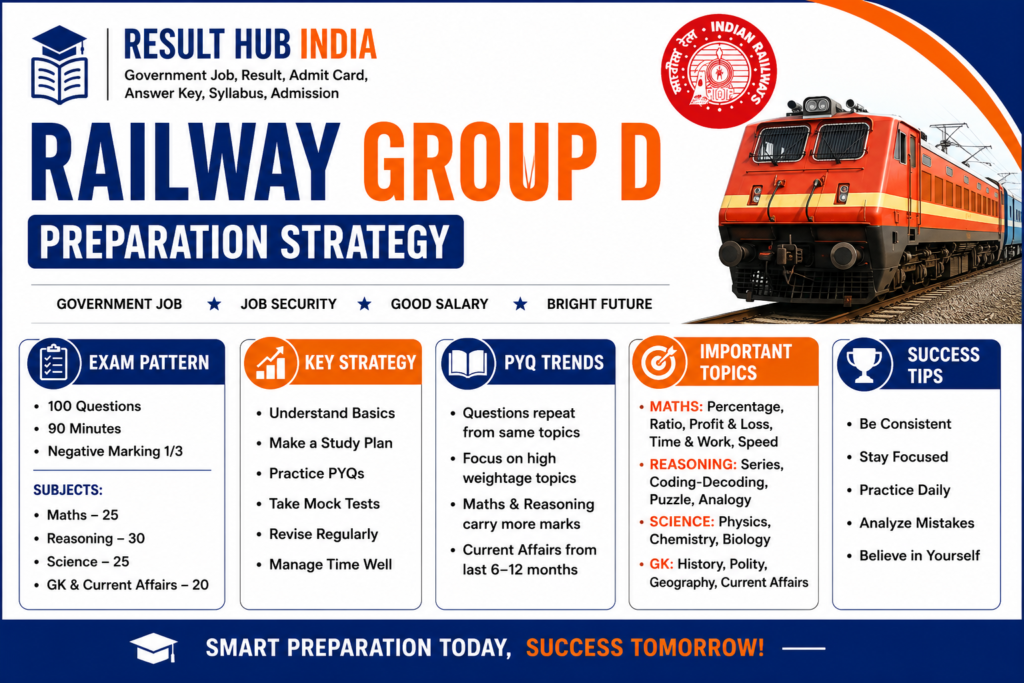
Railway Group D is one of the most popular government examinations conducted by the Railway Recruitment Board (RRB). Every year, millions of candidates apply for Railway Group D vacancies because of job security, attractive salary, government benefits, and career stability.
However, due to intense competition, simply studying hard is not enough. Candidates need a smart preparation strategy, a proper understanding of Previous Year Question (PYQ) trends, and a structured study plan to maximize their chances of success.
In this comprehensive guide, we will discuss the latest Railway Group D exam pattern, subject-wise preparation strategies, PYQ analysis, commonly repeated topics, time management techniques, and expert tips to help you crack the examination.
Railway Group D Exam Overview
Railway Group D recruitment is conducted by the Railway Recruitment Board (RRB) for various posts such as:
- Track Maintainer
- Helper
- Assistant Pointsman
- Assistant Workshop Staff
- Hospital Attendant
- Porter
- Gateman
The selection process generally includes:
Stage 1: Computer Based Test (CBT)
Stage 2: Physical Efficiency Test (PET)
Stage 3: Document Verification
Stage 4: Medical Examination
Among these stages, the CBT plays the most important role in shortlisting candidates.
Railway Group D Exam Pattern
| Subject | Questions |
|---|---|
| Mathematics | 25 |
| General Intelligence & Reasoning | 30 |
| General Science | 25 |
| General Awareness & Current Affairs | 20 |
Total Questions
100 Questions
Total Marks
100 Marks
Duration
90 Minutes
Negative Marking
1/3 Mark Deduction
Why PYQ Analysis is Important
Most successful candidates spend significant time analyzing Previous Year Questions because:
- Exam patterns repeat frequently
- Important topics can be identified
- Question difficulty becomes predictable
- Accuracy improves
- Time management becomes easier
Many Railway Group D questions are concept-based rather than completely new.
Railway Group D PYQ Trends Analysis
After analyzing previous Railway Group D examinations, several patterns emerge.
Mathematics PYQ Trends
Mathematics contributes significantly to overall score.
Most Repeated Topics
- Percentage
- Profit and Loss
- Ratio and Proportion
- Simple Interest
- Compound Interest
- Average
- Time and Work
- Time, Speed and Distance
- Number System
- Simplification
- Mensuration
- Geometry
Trend Observation
Approximately 60-70% of questions consistently come from these chapters.
Preparation Strategy
- Practice calculations daily
- Memorize formulas
- Solve at least 50 questions every day
- Focus on speed and accuracy
Reasoning PYQ Trends
Reasoning is often the highest-scoring section.
Frequently Repeated Topics
- Analogy
- Classification
- Coding-Decoding
- Number Series
- Alphabet Series
- Blood Relations
- Direction Sense
- Puzzle
- Venn Diagram
- Syllogism
Trend Observation
Series and Coding-Decoding questions appear in almost every shift.
Preparation Strategy
- Practice reasoning daily
- Focus on logical thinking
- Solve sectional tests regularly
General Science PYQ Trends
General Science is one of the most important sections.
Physics Topics
- Motion
- Force
- Work and Energy
- Electricity
- Light
- Sound
Chemistry Topics
- Acids and Bases
- Metals and Non-Metals
- Chemical Reactions
- Periodic Table
Biology Topics
- Human Body
- Nutrition
- Diseases
- Plant Physiology
- Genetics
Trend Observation
Most questions are based on NCERT Class 8–10 concepts.
Preparation Strategy
- Read NCERT books thoroughly
- Revise short notes regularly
- Practice science quizzes
General Awareness PYQ Trends
General Awareness can significantly boost your score.
Frequently Asked Areas
- Current Affairs
- Indian History
- Geography
- Indian Constitution
- Sports
- Awards
- Important Days
- Books and Authors
- Government Schemes
Trend Observation
Current Affairs from the last 6–12 months frequently appear.
Preparation Strategy
- Read current affairs daily
- Revise monthly PDFs
- Prepare static GK notes
Subject-Wise Weightage Analysis
Mathematics
Expected Questions:
20–25 Questions
Safe Attempt:
18–22 Questions
Reasoning
Expected Questions:
25–30 Questions
Safe Attempt:
22–27 Questions
General Science
Expected Questions:
20–25 Questions
Safe Attempt:
18–22 Questions
General Awareness
Expected Questions:
15–20 Questions
Safe Attempt:
12–16 Questions
6-Month Railway Group D Preparation Plan
Month 1-2
Focus Areas
- Complete Mathematics basics
- Learn Reasoning fundamentals
- Read NCERT Science
Daily Study Time:
4–5 Hours
Month 3-4
Focus Areas
- Advanced practice
- PYQ solving
- Current Affairs preparation
Daily Study Time:
5–6 Hours
Month 5
Focus Areas
- Full-length mock tests
- Weak area improvement
Daily Study Time:
6–7 Hours
Month 6
Focus Areas
- Revision
- Mock Tests
- Formula Revision
- Current Affairs Revision
Daily Study Time:
6–8 Hours
Common Mistakes Made by Railway Group D Aspirants
Ignoring Previous Year Papers
Many candidates underestimate the importance of PYQs.
Focusing Only on Mathematics
Balanced preparation across all subjects is essential.
Neglecting Current Affairs
Current Affairs can provide easy scoring opportunities.
Lack of Mock Test Practice
Mock tests improve exam temperament and speed.
Poor Time Management
Many candidates know answers but fail due to slow solving speed.
Best Books for Railway Group D Preparation
Mathematics
- Fast Track Arithmetic
- Railway Mathematics Guide
Reasoning
- Verbal & Non-Verbal Reasoning
Science
- NCERT Class 8–10 Science
General Awareness
- Lucent General Knowledge
- Monthly Current Affairs Magazines
Target Score for Railway Group D
Based on previous trends:
General Category
Aim for 75+ Marks
OBC Category
Aim for 70+ Marks
SC/ST Category
Aim for 60–65+ Marks
Always target scores above the expected cut-off to remain on the safe side.
Final Success Strategy
Daily Routine
- Mathematics: 2 Hours
- Reasoning: 1.5 Hours
- Science: 1.5 Hours
- General Awareness: 1 Hour
- Mock Test: 1 Hour
Weekly Plan
- 2 Full-Length Mock Tests
- PYQ Revision
- Formula Revision
- Current Affairs Revision
Consistency matters more than studying long hours occasionally.
Conclusion
Railway Group D is one of the best opportunities for candidates seeking a secure government job. Success in the examination depends on smart preparation, understanding PYQ trends, regular mock test practice, and consistent revision.
Candidates who focus on high-frequency topics, analyze previous year papers, and maintain accuracy can significantly improve their chances of selection. Follow a disciplined study plan, stay updated with current affairs, and practice regularly to achieve your dream Railway job.
FAQs
1. Is Railway Group D difficult to crack?
No. With proper preparation and regular practice, Railway Group D can be cleared successfully.
2. How many hours should I study daily?
A minimum of 4–6 hours daily is recommended.
3. Are previous year questions important?
Yes. Railway Group D often follows similar concepts and patterns.
4. Which subject is most important?
Mathematics and Reasoning usually contribute the highest scores.
5. How many mock tests should I attempt?
At least 20–30 full-length mock tests before the exam.
6. Is NCERT enough for Science?
NCERT Class 8–10 Science covers most important topics.
7. What is a safe score in Railway Group D?
Generally, 75+ marks is considered a safe target.
8. Does Railway Group D have negative marking?
Yes, one-third mark is deducted for each wrong answer.
9. How should I revise current affairs?
Use monthly current affairs PDFs and weekly revision.
10. Can I crack Railway Group D without coaching?
Yes. Many candidates clear the exam through self-study, PYQs, and mock tests.