
INTRODUCTION
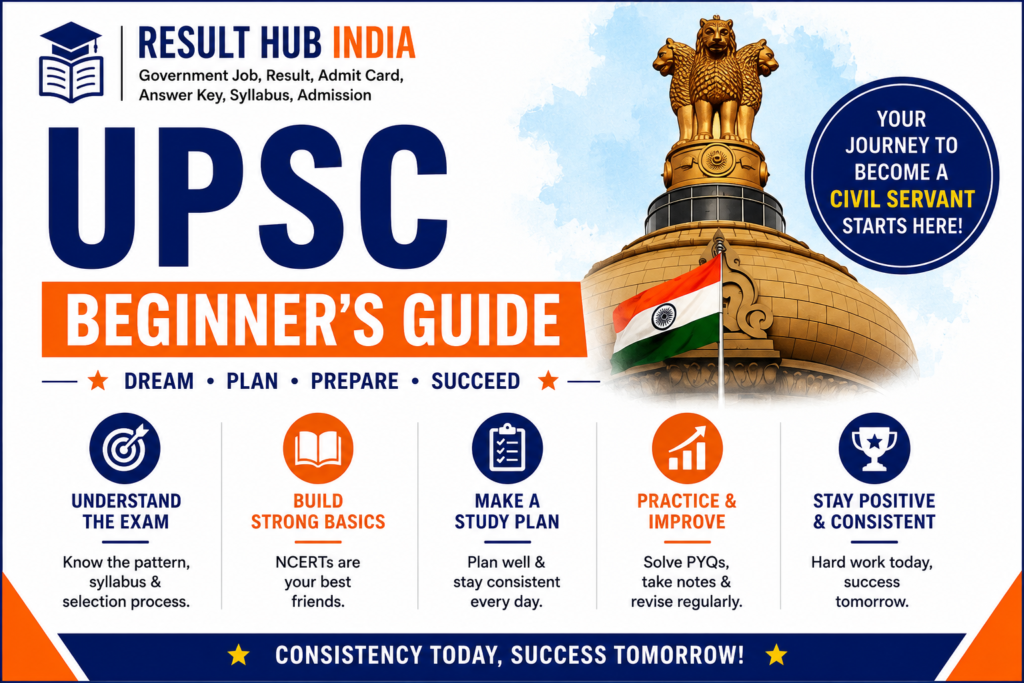
The Union Public Service Commission (UPSC) Civil Services Examination is considered one of the most prestigious and challenging competitive exams in India. Every year, lakhs of aspirants dream of becoming IAS, IPS, IFS, IRS, and other Group A officers through this examination.
For beginners, UPSC preparation can seem overwhelming because of its vast syllabus, lengthy preparation process, and high competition. Many students struggle because they do not know where to start, what books to read, how to make notes, or how to plan their preparation.
This comprehensive UPSC Beginner’s Guide will provide a step-by-step roadmap to help aspirants understand the exam pattern, syllabus, preparation strategy, booklist, and common mistakes to avoid.
Whether you are a school student, college graduate, working professional, or first-time aspirant, this guide will help you start your UPSC journey with confidence.
What is UPSC?
The Union Public Service Commission (UPSC) is India’s premier recruiting agency responsible for conducting examinations for various central government services.
The most popular UPSC exam is the Civil Services Examination (CSE), through which candidates are selected for prestigious services such as:
- Indian Administrative Service (IAS)
- Indian Police Service (IPS)
- Indian Foreign Service (IFS)
- Indian Revenue Service (IRS)
- Indian Audit and Accounts Service (IAAS)
- Indian Railway Management Service (IRMS)
These officers play a crucial role in governance, administration, law enforcement, taxation, foreign affairs, and policymaking.
Why Choose UPSC?
UPSC remains one of the most respected career paths in India because it offers:
1. Social Prestige
IAS and IPS officers enjoy immense respect in society.
2. Job Security
Civil servants enjoy stable careers and excellent benefits.
3. Leadership Opportunities
Officers directly contribute to public administration and policymaking.
4. Attractive Salary
Government officers receive competitive salaries, allowances, and retirement benefits.
5. Nation Building
UPSC officers contribute to the development and progress of the country.
UPSC Exam Structure
The Civil Services Examination consists of three stages:
Stage 1: Preliminary Examination (Prelims)
The Preliminary Examination serves as a screening test.
Paper I: General Studies
- Current Affairs
- History
- Geography
- Polity
- Economy
- Environment
- Science and Technology
Paper II: CSAT
- Logical Reasoning
- Reading Comprehension
- Quantitative Aptitude
- Decision Making
Marks
- GS Paper I: 200 Marks
- CSAT: 200 Marks (Qualifying)
Stage 2: Main Examination (Mains)
Candidates who clear Prelims appear for the Mains Examination.
Papers Included
- Essay
- General Studies I
- General Studies II
- General Studies III
- General Studies IV
- Optional Subject Paper I
- Optional Subject Paper II
The Mains examination tests analytical thinking, writing skills, and conceptual understanding.
Stage 3: Personality Test (Interview)
Candidates who clear Mains are called for the UPSC Interview.
The interview evaluates:
- Personality
- Communication Skills
- Decision-Making Ability
- Leadership Qualities
- Awareness of National and International Issues
UPSC Eligibility Criteria
Educational Qualification
Candidates must possess a bachelor’s degree from a recognized university.
Age Limit
General Category
21–32 Years
OBC Category
21–35 Years
SC/ST Category
21–37 Years
Understanding the UPSC Syllabus
Before starting preparation, thoroughly understand the syllabus.
Major subjects include:
- Indian Polity
- History
- Geography
- Economics
- Environment
- Current Affairs
- Ethics
- Science and Technology
- International Relations
The syllabus acts as the foundation of UPSC preparation.
UPSC Preparation Strategy for Beginners
Step 1: Understand the Exam
Many aspirants start collecting books without understanding the exam pattern.
Spend the first week studying:
- UPSC Notification
- Exam Pattern
- Syllabus
- Previous Year Question Papers
Step 2: Read NCERT Books
NCERT books provide conceptual clarity and are highly recommended for beginners.
Important NCERT Subjects
- History
- Geography
- Economics
- Political Science
- Sociology
- Science
Class 6–12 NCERTs build a strong foundation.
Step 3: Read Standard Reference Books
After NCERTs, move to standard UPSC books.
Recommended Books
Polity
M. Laxmikanth
Modern History
Spectrum Publication
Geography
GC Leong
Economics
Basic Economics Texts
Environment
Shankar IAS Environment
These books are widely used by successful candidates.
Step 4: Develop Newspaper Reading Habit
Current affairs are crucial for all three stages of UPSC.
Spend 45–60 minutes daily reading newspapers.
Focus on:
- Government Policies
- International Relations
- Economy
- Environment
- Supreme Court Judgments
Avoid unnecessary political controversies and sensational news.
Step 5: Make Notes
Note-making is essential.
Create concise notes for:
- Current Affairs
- Polity
- Geography
- Economics
- Government Schemes
Short notes help during revision.
Step 6: Start Answer Writing Practice
Many beginners ignore answer writing.
Start writing answers after completing basic subjects.
Benefits include:
- Better Presentation
- Improved Speed
- Strong Analytical Thinking
- Effective Revision
Step 7: Choose Optional Subject Carefully
Optional subjects contribute significantly to the final score.
Choose based on:
- Interest
- Academic Background
- Availability of Resources
- Previous Success Trends
Popular optionals include:
- Political Science
- Geography
- Sociology
- History
- Public Administration
Step 8: Solve Previous Year Papers
Previous year papers reveal:
- Question Trends
- Important Topics
- Difficulty Levels
Solve at least 10 years of UPSC question papers.
Step 9: Take Mock Tests
Mock tests improve:
- Time Management
- Accuracy
- Confidence
- Exam Temperament
Regular practice significantly increases success rates.
Common Mistakes Beginners Must Avoid
1. Collecting Too Many Books
Stick to limited and standard resources.
2. Ignoring Current Affairs
Current affairs are vital for Prelims, Mains, and Interview.
3. Skipping Revision
Revision is the key to retention.
4. Not Practicing Answer Writing
Writing practice is essential for Mains success.
5. Following Multiple Strategies
Choose one reliable strategy and remain consistent.
One-Year UPSC Study Plan for Beginners
Months 1–3
- NCERT Reading
- Syllabus Analysis
- Newspaper Reading
Months 4–6
- Standard Books
- Note Making
- Basic Current Affairs
Months 7–9
- Answer Writing
- Mock Tests
- Optional Subject Preparation
Months 10–12
- Revision
- Test Series
- Previous Year Papers
Consistency matters more than study hours.
Can Working Professionals Prepare for UPSC?
Yes.
Many successful candidates have cleared UPSC while working full-time.
Tips:
- Study 3–5 hours daily
- Utilize weekends effectively
- Focus on quality rather than quantity
- Follow a disciplined routine
Is Coaching Necessary for UPSC?
No.
Many toppers have cleared UPSC through self-study.
Coaching can provide guidance, but success depends on:
- Consistency
- Discipline
- Revision
- Practice
Final Thoughts
UPSC is not merely an examination; it is a journey that tests patience, dedication, and perseverance. Every successful civil servant once started as a beginner with doubts and uncertainties.
The key to cracking UPSC is not extraordinary intelligence but consistent effort, strategic preparation, and disciplined execution.
Understand the syllabus, build strong fundamentals, practice regularly, revise consistently, and stay motivated throughout the process.
With the right approach and determination, your dream of becoming an IAS, IPS, or IRS officer can become a reality.
Frequently Asked Questions (FAQs)
Q1. How many years are required for UPSC preparation?
Most candidates require 1–2 years of focused preparation.
Q2. Can beginners start UPSC preparation without coaching?
Yes. Many successful candidates clear UPSC through self-study.
Q3. Which degree is best for UPSC?
Any graduation degree is acceptable. UPSC does not favor a specific degree.
Q4. How many hours should I study daily for UPSC?
Generally, 6–8 focused hours are sufficient.
Q5. Is UPSC tougher than SSC CGL?
Yes, UPSC has a broader syllabus and a more complex selection process.
Q6. Which newspaper is best for UPSC preparation?
National newspapers and quality current affairs sources are recommended.
Q7. Can I prepare for UPSC during college?
Yes. Starting during graduation provides a significant advantage.
Q8. How important are NCERT books?
NCERT books are extremely important for building conceptual clarity.
Q9. What is the success rate in UPSC?
The success rate is low due to intense competition, making smart preparation essential.
Q10. Can average students crack UPSC?
Absolutely. Consistency and strategy matter more than academic background