
Introduction
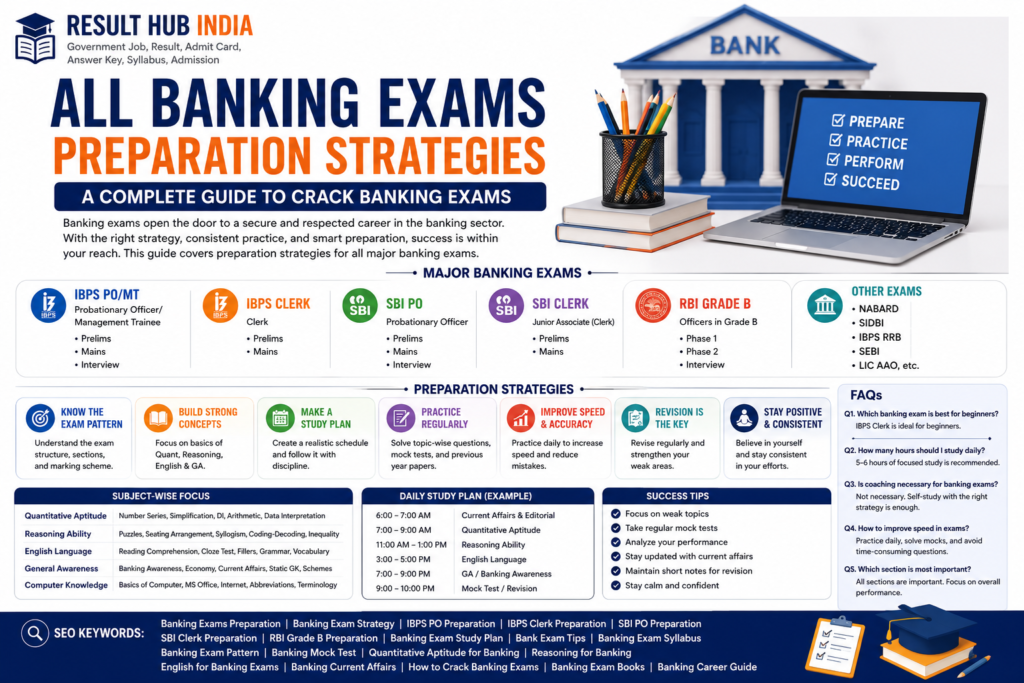
Banking jobs are among the most sought-after career options in India due to their attractive salary packages, job security, career growth opportunities, and professional work environment. Every year, millions of aspirants apply for various banking examinations conducted by organizations such as IBPS, SBI, RBI, NABARD, and other financial institutions.
However, due to increasing competition, cracking banking exams requires a well-planned preparation strategy, consistency, and smart study techniques. Many candidates fail not because of a lack of knowledge but because they do not follow a structured preparation plan.
In this comprehensive guide, we will discuss the preparation strategy for all major banking exams, including IBPS PO, IBPS Clerk, SBI PO, SBI Clerk, RBI Assistant, RBI Grade B, and NABARD exams. This article will help beginners and experienced aspirants understand the exam pattern, syllabus, study plan, and preparation tips needed to succeed in 2026.
Why Choose a Banking Career?
Before discussing preparation strategies, let’s understand why banking jobs remain highly popular.
Benefits of Banking Jobs
- Attractive Salary Packages
- Job Security
- Promotion Opportunities
- Professional Work Environment
- Work-Life Balance
- Medical Benefits
- Pension and Retirement Benefits
- Opportunities for Growth
Banking professionals enjoy respectable positions in society along with financial stability.
Major Banking Exams in India
1. IBPS PO
The Institute of Banking Personnel Selection conducts the Probationary Officer examination for public sector banks.
Eligibility
- Graduation from a recognized university
Salary
₹52,000 – ₹75,000 per month
2. IBPS Clerk
IBPS Clerk recruits candidates for clerical positions in public sector banks.
Eligibility
- Graduation
Salary
₹35,000 – ₹50,000 per month
3. SBI PO
State Bank of India conducts SBI PO recruitment annually.
Salary
₹60,000 – ₹90,000 per month
Benefits
- High Salary
- Fast Career Growth
- Prestige
4. SBI Clerk
One of the most popular banking exams for graduates.
Salary
₹35,000 – ₹45,000 per month
5. RBI Assistant
The Reserve Bank of India conducts RBI Assistant recruitment.
Salary
₹45,000 – ₹55,000 per month
6. RBI Grade B
RBI Grade B is considered one of the most prestigious banking jobs.
Salary
₹80,000 – ₹1,20,000+ per month
7. NABARD Grade A
NABARD recruits officers for rural development and agricultural banking.
Salary
₹70,000 – ₹1,00,000 per month
Banking Exam Pattern Overview
Most banking examinations follow a similar structure.
Preliminary Examination
Subjects include:
English Language
- Reading Comprehension
- Cloze Test
- Error Detection
- Vocabulary
Quantitative Aptitude
- Simplification
- Number Series
- Arithmetic
- Data Interpretation
Reasoning Ability
- Seating Arrangement
- Puzzles
- Coding-Decoding
- Syllogism
Main Examination
Additional sections include:
- General Awareness
- Banking Awareness
- Computer Knowledge
- Data Analysis
- Financial Awareness
Understanding the Banking Exam Syllabus
The first step toward success is understanding the syllabus thoroughly.
Quantitative Aptitude
Topics include:
- Percentage
- Profit and Loss
- Ratio and Proportion
- Time and Work
- Time, Speed and Distance
- Simple and Compound Interest
- Data Interpretation
Reasoning Ability
Important topics:
- Puzzle
- Seating Arrangement
- Blood Relations
- Coding-Decoding
- Input-Output
- Logical Reasoning
English Language
Topics include:
- Grammar
- Vocabulary
- Reading Comprehension
- Para Jumbles
- Cloze Test
General Awareness
Includes:
- Current Affairs
- Banking Awareness
- Financial Awareness
- Government Schemes
- Static GK
Complete Banking Exam Preparation Strategy
Step 1: Understand the Exam Pattern
Before starting preparation, carefully analyze:
- Syllabus
- Exam Pattern
- Previous Year Papers
- Cut-Off Trends
This provides a clear understanding of the examination.
Step 2: Create a Realistic Study Plan
A proper timetable increases productivity.
Daily Schedule Example
- Quantitative Aptitude: 2 Hours
- Reasoning Ability: 2 Hours
- English Language: 1 Hour
- Current Affairs: 1 Hour
- Mock Test Analysis: 1 Hour
Consistency is more important than studying for long hours.
Step 3: Strengthen Quantitative Aptitude
Quantitative Aptitude is a scoring section if prepared properly.
Focus Areas
- Basic Mathematics
- Speed Calculation
- Short Tricks
- Data Interpretation
Practice at least 30–50 questions daily.
Step 4: Master Reasoning Ability
Reasoning plays a crucial role in bank examinations.
High-Weightage Topics
- Puzzles
- Seating Arrangement
- Inequality
- Syllogism
- Coding-Decoding
Daily practice significantly improves performance.
Step 5: Improve English Language Skills
Many candidates struggle with English.
Preparation Tips
- Read newspapers daily
- Learn new vocabulary
- Practice grammar exercises
- Solve comprehension passages
Even 30 minutes of daily practice can produce excellent results.
Step 6: Focus on Current Affairs
Current affairs are essential for Mains examinations.
Important Areas
- Banking News
- RBI Policies
- Government Schemes
- International Events
- Economic Developments
Prepare monthly current affairs notes.
Step 7: Banking Awareness Preparation
For Banking Mains exams, candidates must understand:
- RBI Functions
- Monetary Policy
- Financial Institutions
- Banking Terminology
- Financial Markets
Banking awareness can significantly improve overall scores.
Step 8: Practice Mock Tests
Mock tests are one of the most important components of preparation.
Benefits
- Time Management
- Accuracy Improvement
- Confidence Building
- Weak Area Identification
Attempt at least two to three mock tests every week.
Step 9: Analyze Every Mock Test
Many candidates attempt tests but do not analyze them.
Review:
- Wrong Answers
- Time-Consuming Questions
- Weak Sections
Improvement comes through analysis.
Step 10: Solve Previous Year Papers
Previous year papers help understand:
- Question Trends
- Difficulty Levels
- Frequently Asked Topics
Solve at least five years of previous papers.
Three-Month Banking Exam Study Plan
Month 1
Focus on:
- Basics of Quantitative Aptitude
- Basic Reasoning
- Grammar
- Current Affairs
Month 2
Focus on:
- Advanced Puzzles
- Data Interpretation
- Banking Awareness
- Mock Tests
Month 3
Focus on:
- Revision
- Full-Length Mock Tests
- Previous Year Papers
- Speed Improvement
Common Mistakes to Avoid
1. Ignoring Current Affairs
Current affairs carry significant weight in Mains examinations.
2. Lack of Practice
Regular practice is essential.
3. Skipping Mock Tests
Mock tests improve exam performance.
4. Studying Too Many Books
Stick to limited and reliable resources.
5. Poor Time Management
Time management is often the deciding factor.
Best Books for Banking Exam Preparation
Quantitative Aptitude
R.S. Aggarwal
Reasoning
R.S. Aggarwal
English
Wren and Martin
Banking Awareness
Standard Banking Awareness Books
Current Affairs
Monthly Current Affairs Magazines
How Many Hours Should You Study?
Beginners
4–5 Hours Daily
Serious Aspirants
6–8 Hours Daily
Quality of study matters more than quantity.
Final Tips to Crack Banking Exams
- Stay Consistent
- Revise Regularly
- Practice Daily
- Analyze Mock Tests
- Improve Accuracy
- Stay Updated with Current Affairs
- Maintain a Positive Attitude
Success in banking exams depends on disciplined preparation and smart strategy.
Conclusion
Banking exams offer excellent career opportunities for graduates seeking stable and rewarding careers. Whether your goal is IBPS PO, SBI PO, RBI Grade B, or NABARD, success requires a strong understanding of concepts, continuous practice, and effective time management.
By following a structured preparation strategy, solving mock tests regularly, and staying updated with current affairs, candidates can significantly improve their chances of selection. Consistency, patience, and dedication remain the keys to cracking any banking examination.
FAQs
Q1. Which banking exam is easiest for beginners?
IBPS Clerk and SBI Clerk are generally considered suitable for beginners.
Q2. How many months are sufficient for banking exam preparation?
Most candidates require 4–6 months of focused preparation.
Q3. Is coaching necessary for banking exams?
No. Many candidates clear banking exams through self-study.
Q4. Which banking job has the highest salary?
RBI Grade B is among the highest-paying banking jobs.
Q5. How important are mock tests?
Mock tests are crucial for improving speed, accuracy, and confidence.
Q6. Can final-year students apply for banking exams?
Candidates must meet the eligibility requirements mentioned in the official notification.
Q7. Which subject is most important in banking exams?
Reasoning and Quantitative Aptitude usually carry significant weight.
Q8. How can I improve my English for banking exams?
Read newspapers, practice grammar, and solve comprehension passages regularly.
Q9. Are banking jobs secure?
Yes, banking jobs offer good job security and career growth.
Q10. Can working professionals prepare for banking exams?
Yes. Many candidates successfully prepare while working full-time.