
Which Career Path is Better in 2026?
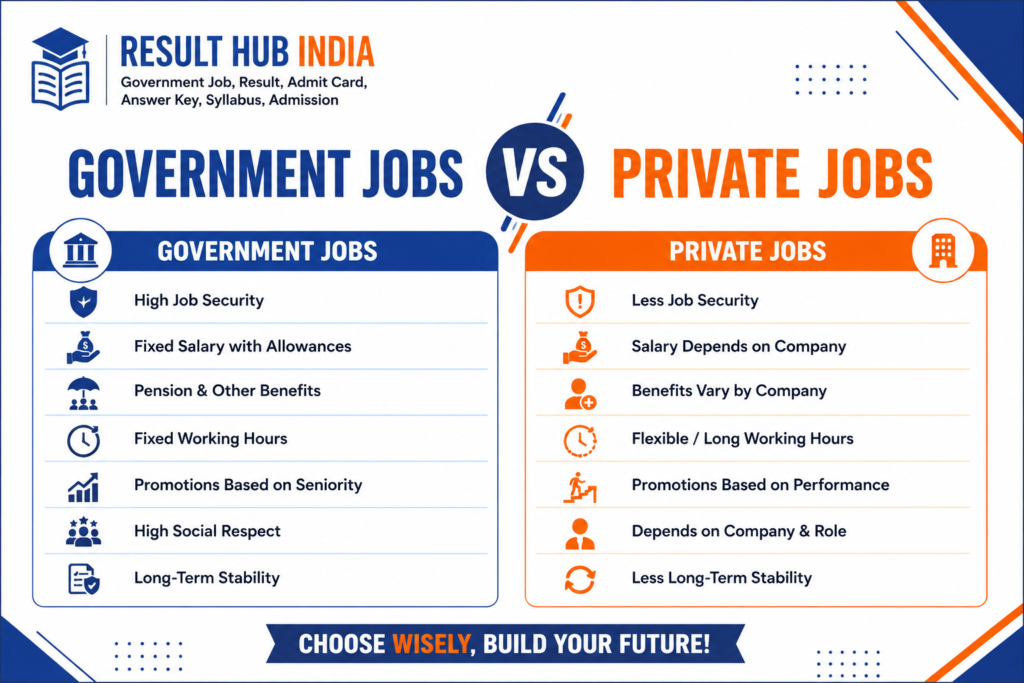
Choosing between a government job and a private job is one of the biggest career decisions for students and job seekers in India. Every year, millions of candidates prepare for government exams like SSC CGL, UPSC, Banking, Railway, and State PSC, while others pursue careers in private companies, startups, and multinational corporations.
The debate of Government Jobs vs Private Jobs has existed for decades because both sectors offer unique advantages and challenges. While government jobs are known for stability and security, private jobs provide faster growth, higher salaries, and dynamic work environments.
In this comprehensive guide, we will compare government and private jobs based on salary, job security, work-life balance, career growth, promotions, benefits, and future opportunities to help you make an informed career decision.
What is a Government Job?
A government job refers to employment under the Central Government, State Government, Public Sector Undertakings (PSUs), Railways, Banks, Defense Services, and other government departments.
Popular government job sectors include:
- SSC CGL
- UPSC Civil Services
- Railway Jobs
- Banking Jobs
- State Government Jobs
- Defense Services
- Teaching Jobs
- Public Sector Undertakings (PSUs)
Government jobs are often considered prestigious because they offer stability, pension benefits, and social respect.
What is a Private Job?
A private job refers to employment in privately owned companies, startups, multinational corporations (MNCs), and business organizations.
Popular private sectors include:
- Information Technology (IT)
- Software Development
- Finance
- Marketing
- Sales
- Human Resources
- Digital Marketing
- Healthcare
- Manufacturing
Private jobs are known for innovation, performance-based growth, and higher earning potential.
Government Jobs vs Private Jobs: Detailed Comparison
1. Job Security
Government Jobs
One of the biggest advantages of government jobs is job security. Once selected, employees rarely face termination unless there is serious misconduct.
Benefits include:
- Stable employment
- Low risk of layoffs
- Long-term career security
- Fixed retirement benefits
Private Jobs
Private jobs are performance-driven. Companies may downsize or restructure during economic downturns.
Challenges include:
- Risk of layoffs
- Performance pressure
- Market fluctuations
- Frequent organizational changes
Winner: Government Jobs
For candidates seeking stability and long-term security, government jobs are the clear winner.
2. Salary Comparison
Government Jobs
Government employees receive:
- Basic Pay
- Dearness Allowance (DA)
- House Rent Allowance (HRA)
- Travel Allowance (TA)
- Medical Benefits
Example:
An SSC CGL officer can earn between ₹45,000 and ₹80,000 per month initially.
Private Jobs
Private sector salaries vary significantly.
For example:
- Software Engineers: ₹4–20 LPA+
- Data Scientists: ₹8–30 LPA+
- Investment Bankers: ₹10–50 LPA+
High performers can earn substantially more than government employees.
Winner: Private Jobs
Private sector jobs generally offer higher earning potential.
3. Career Growth
Government Jobs
Promotions are often based on:
- Seniority
- Departmental exams
- Years of service
Growth is stable but slower.
Private Jobs
Promotions depend on:
- Skills
- Performance
- Leadership abilities
- Innovation
Fast learners can rise quickly to managerial positions.
Winner: Private Jobs
Private jobs offer faster career progression.
4. Work-Life Balance
Government Jobs
Government jobs generally have:
- Fixed working hours
- Public holidays
- Paid leave
- Less work pressure
Employees often enjoy better personal and family time.
Private Jobs
Private jobs may require:
- Overtime work
- Weekend tasks
- Tight deadlines
- Project-based schedules
Work-life balance varies by company.
Winner: Government Jobs
Government employees usually enjoy a healthier work-life balance.
5. Retirement Benefits
Government Jobs
Government employees receive:
- Pension benefits (where applicable)
- Provident Fund
- Gratuity
- Medical facilities
These benefits provide financial security after retirement.
Private Jobs
Most private companies offer:
- Provident Fund
- Gratuity
- Retirement savings plans
However, pension schemes are less common.
Winner: Government Jobs
Government jobs offer stronger retirement benefits.
6. Learning Opportunities
Government Jobs
Learning opportunities exist but may be limited depending on the department.
Training programs are generally structured and periodic.
Private Jobs
Private companies constantly adopt:
- New technologies
- Modern tools
- Industry trends
Employees regularly upgrade their skills.
Winner: Private Jobs
Private jobs provide greater exposure to innovation and skill development.
7. Social Status and Respect
Government officers are often highly respected in society.
Examples include:
- IAS Officers
- IPS Officers
- SSC CGL Officers
- Bank Managers
- Railway Officers
Government positions are associated with authority and public service.
Private professionals are also respected, especially in high-paying industries like IT and finance.
Winner: Government Jobs
Government jobs traditionally enjoy greater social prestige.
8. Transfer Policy
Government Jobs
Many government positions involve transfers across cities and states.
This can be beneficial for some but challenging for others.
Private Jobs
Employees usually remain in one location unless they choose relocation opportunities.
Winner: Private Jobs
Private jobs generally offer more location flexibility.
9. Competition Level
Government exams are highly competitive.
Examples:
- SSC CGL
- UPSC
- Banking Exams
- Railway Recruitment
Lakhs of candidates compete for limited vacancies.
Private sector recruitment focuses more on skills and qualifications.
Winner: Private Jobs
Private jobs are comparatively easier to enter.
10. Future Scope in 2026 and Beyond
Government Sector
Demand will remain strong for:
- SSC CGL
- UPSC
- Banking
- Railways
- Defense
Government jobs will continue offering stability.
Private Sector
Growth areas include:
- Artificial Intelligence
- Data Science
- Cybersecurity
- Cloud Computing
- Digital Marketing
- FinTech
The private sector is expected to create millions of new jobs.
Winner: Both
The best choice depends on individual goals and personality.
Who Should Choose Government Jobs?
Government jobs are ideal for people who:
- Prefer stability
- Want fixed working hours
- Seek long-term security
- Value social respect
- Prefer predictable career growth
Who Should Choose Private Jobs?
Private jobs are ideal for people who:
- Love challenges
- Want rapid growth
- Seek higher salaries
- Enjoy learning new technologies
- Are comfortable with performance-based environments
Government Jobs vs Private Jobs: Final Verdict
There is no universal winner between government and private jobs.
Choose a government job if you prioritize security, benefits, work-life balance, and social prestige.
Choose a private job if you prioritize salary growth, innovation, skill development, and fast promotions.
Success ultimately depends on your dedication, skills, and career goals rather than the sector you choose.
Frequently Asked Questions (FAQs)
Q1. Which is better: Government job or private job?
Both have advantages. Government jobs offer security, while private jobs offer faster growth and higher salaries.
Q2. Do government jobs provide better work-life balance?
Yes. Most government jobs have fixed working hours and less work pressure.
Q3. Can private jobs pay more than government jobs?
Yes. Skilled professionals in IT, finance, and management often earn significantly more than government employees.
Q4. Are government jobs completely secure?
Government jobs are among the most secure careers, though employees must still maintain professional conduct.
Q5. Is SSC CGL better than a private job?
It depends on your priorities. SSC CGL offers stability and benefits, while private jobs may offer faster salary growth.
Q6. Which sector has more career growth opportunities?
Private jobs generally provide faster promotions and career advancement.
Q7. Are government jobs difficult to get?
Yes. Competitive exams like SSC, UPSC, Banking, and Railways have high competition levels.
Q8. Which job is best for fresh graduates?
Fresh graduates can explore both sectors depending on their skills, interests, and career goals.
Q9. Which sector is safer during economic recessions?
Government jobs are generally safer during economic downturns.
Q10. Can I switch from a private job to a government job?
Yes. Many professionals prepare for competitive exams while working in the private sector.