
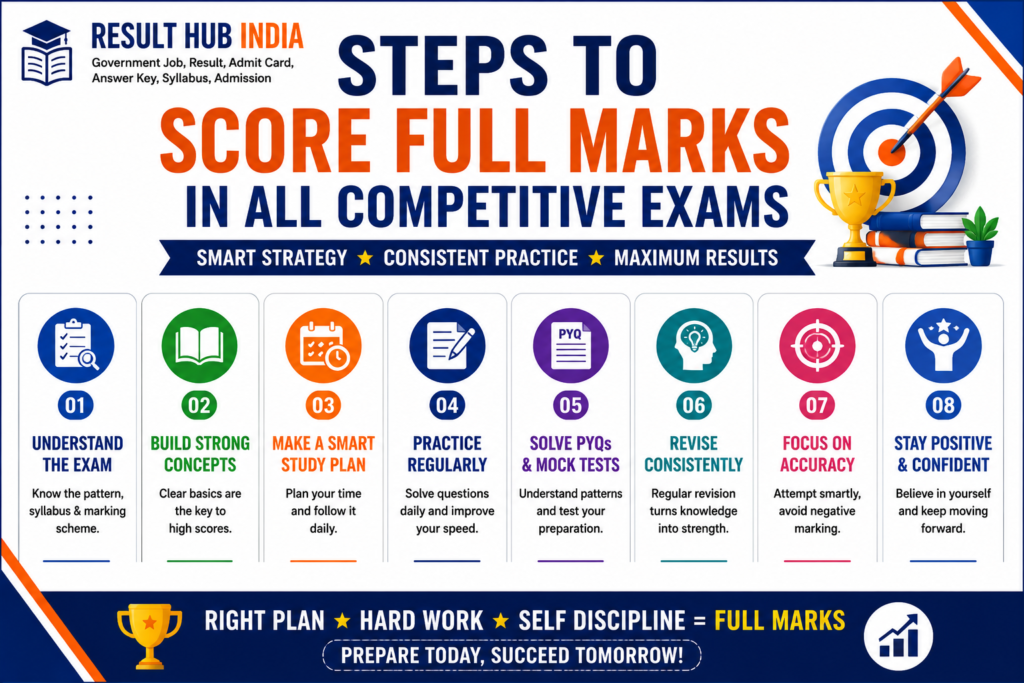
How to Score Maximum Marks in Government Competitive Exams
Every year, millions of candidates appear for government competitive examinations such as SSC CGL, SSC CHSL, Railway Group D, RRB NTPC, UPSC, Banking Exams, Bihar Police, State PSC, Defence Exams, and various recruitment tests. However, only a small percentage of candidates achieve top ranks and secure government jobs.
The secret behind their success is not extraordinary intelligence but a well-planned strategy, disciplined preparation, consistent revision, and smart exam techniques. While scoring an absolute 100% may not always be realistic due to exam difficulty and negative marking, candidates can certainly maximize their scores and significantly increase their chances of selection.
This comprehensive guide discusses the most effective steps to achieve top scores in government exams and build a preparation strategy that leads to success.
Understand the Exam Thoroughly
Before starting preparation, understand the examination completely.
Analyze:
- Exam Pattern
- Syllabus
- Marking Scheme
- Negative Marking
- Previous Year Cut-Offs
- Subject Weightage
Many candidates start studying without understanding the exam structure, leading to wasted effort.
Why It Matters
A clear understanding of the exam helps prioritize important topics and manage preparation effectively.
Create a Realistic Study Plan
A structured study plan is the foundation of success.
Daily Schedule Example
- Quantitative Aptitude – 2 Hours
- Reasoning – 1.5 Hours
- English/Hindi – 1 Hour
- General Awareness – 1 Hour
- Current Affairs – 30 Minutes
- Revision – 1 Hour
Benefits
- Improves consistency
- Prevents procrastination
- Covers the syllabus systematically
Remember, consistency beats occasional long study sessions.
Master the Complete Syllabus
Top scorers rarely leave important topics untouched.
Focus on:
Quantitative Aptitude
- Percentage
- Profit and Loss
- Ratio and Proportion
- Time and Work
- Algebra
- Geometry
Reasoning
- Coding-Decoding
- Series
- Analogy
- Syllogism
- Puzzle
English
- Grammar
- Vocabulary
- Reading Comprehension
General Awareness
- History
- Geography
- Polity
- Economy
- Science
- Current Affairs
Completing the syllabus gives confidence and reduces surprises in the exam.
Practice Previous Year Questions (PYQs)
One of the most effective ways to score high is solving Previous Year Questions.
Benefits of PYQs
- Understand exam trends
- Identify repeated concepts
- Improve speed
- Build confidence
Most competitive exams frequently repeat concepts even when questions differ.
Recommended Strategy
Solve at least the last 5–10 years of question papers.
Build Strong Fundamentals
Many candidates focus only on shortcuts and tricks.
However, shortcuts work only when concepts are clear.
Focus On
- Basic Mathematics Concepts
- Grammar Rules
- Logical Thinking
- Static General Knowledge
Strong fundamentals improve performance across all exams.
Take Regular Mock Tests
Mock tests simulate the actual examination environment.
Advantages
- Improves speed
- Enhances accuracy
- Builds confidence
- Reduces exam anxiety
Recommended Frequency
- Beginner: 1 Mock Weekly
- Intermediate: 2–3 Mocks Weekly
- Advanced: Daily Mocks
Improve Time Management
Time management is crucial in competitive exams.
Effective Strategy
First Round
Solve easy questions quickly.
Second Round
Attempt moderate questions.
Third Round
Focus on difficult questions.
Avoid spending too much time on a single question.
Focus on Accuracy
Many candidates lose marks due to negative marking.
Tips to Improve Accuracy
- Read questions carefully
- Avoid guesswork
- Eliminate wrong options
- Attempt only when reasonably confident
High accuracy often beats high attempts.
Develop Effective Revision Habits
Revision is the key to long-term retention.
Golden Rule
Revise every topic:
- After 1 Day
- After 1 Week
- After 1 Month
Revision Tools
- Short Notes
- Flashcards
- Formula Sheets
- Mind Maps
Regular revision strengthens memory.
Make Short Notes
Top performers often rely on concise notes.
Include
- Important Formulas
- Grammar Rules
- Historical Dates
- Current Affairs Facts
Short notes save time during final revision.
Stay Updated with Current Affairs
Current Affairs are important for:
- SSC
- Banking
- UPSC
- Railways
- State PSC
- Police Exams
Daily Sources
- Newspapers
- Monthly Current Affairs PDFs
- Government Websites
Revision Strategy
Revise monthly current affairs regularly.
Strengthen Weak Areas
Every candidate has weak subjects.
Process
- Identify weak topics.
- Allocate extra study time.
- Solve topic-wise questions.
- Monitor improvement.
Ignoring weaknesses can lower overall scores.
Maintain Physical and Mental Health
Healthy candidates perform better.
Essential Habits
- 7–8 Hours Sleep
- Balanced Diet
- Daily Exercise
- Stress Management
A healthy mind improves concentration and memory.
Avoid Common Preparation Mistakes
Studying Without a Plan
Random preparation often leads to poor results.
Ignoring Revision
Lack of revision causes forgetting.
Avoiding Mock Tests
Mock tests reveal weaknesses.
Following Too Many Sources
Stick to limited quality resources.
Comparing Yourself to Others
Focus on your own progress.
Follow a Smart Resource Strategy
Mathematics
Use one standard book and practice extensively.
Reasoning
Focus on concept-building and practice.
English
Improve grammar and vocabulary daily.
General Awareness
Combine static GK and current affairs.
Quality matters more than quantity.
Learn from Toppers
Successful candidates commonly:
- Follow a timetable
- Revise regularly
- Attempt mock tests
- Analyze mistakes
- Maintain consistency
Their success is based on discipline rather than luck.
The Power of Consistency
Many aspirants study intensely for a few days and then lose momentum.
Better Approach
Study consistently every day.
Even 5 focused hours daily for months can outperform irregular 12-hour sessions.
Exam-Day Strategy
Before the Exam
- Sleep properly
- Revise short notes
- Stay calm
During the Exam
- Read instructions carefully
- Attempt easy questions first
- Manage time wisely
- Avoid panic
After the Exam Starts
Maintain confidence and focus on accuracy.
Final Formula for Success
Success in government exams can be summarized through:
Understand the Exam
Complete the Syllabus
Practice PYQs
Take Mock Tests
Revise Regularly
Improve Accuracy
Stay Consistent
Candidates who follow these principles significantly improve their chances of achieving top scores.
Conclusion
Scoring exceptionally well in government competitive exams requires smart preparation rather than endless studying. A strategic approach involving syllabus completion, PYQ practice, mock tests, revision, current affairs preparation, and consistent effort can help candidates maximize their scores and secure government jobs.
While achieving a perfect 100% score may not always be necessary, aiming for excellence and maintaining discipline throughout the preparation journey will place you ahead of the competition.
Remember, government exam success is not a sprint—it is a marathon of consistency, dedication, and continuous improvement.
FAQs
1. Can I score 100% in government competitive exams?
While achieving an exact 100% is rare, candidates can score exceptionally high with proper preparation.
2. How many hours should I study daily?
5–8 focused hours daily are generally sufficient.
3. Are mock tests important?
Yes. Mock tests improve speed, accuracy, and confidence.
4. How many previous year papers should I solve?
At least 5–10 years of previous papers.
5. What is the best way to revise?
Use short notes, flashcards, and regular revision schedules.
6. Is coaching necessary?
No. Many candidates clear exams through self-study.
7. How important are current affairs?
Very important for most government examinations.
8. How can I improve accuracy?
Practice regularly and avoid blind guessing.
9. Should I study all subjects every day?
Yes, balanced preparation is recommended.
10. What is the biggest reason for failure?
Lack of consistency and poor revision habits.